I trained as a formulator in organic and natural skin care. Essential oils were the standard I learned, the standard I trusted. For a long time, essential oils were the only thing I would put in a product carrying my name. Fragrance oils, in my experience and training, had always been something to avoid, vague, unregulated, and often hiding more than they disclosed.
A Standard I Already Lived By
Synthetic ingredients have never bothered me on principle. My formulas include synthetic niacinamide and synthetic forms of certain vitamins, since their natural form often produces a molecule too large to actually penetrate the skin. Yet when I started this brand, I genuinely did not want anything synthetic in it. Niacinamide challenged that belief first, and I debated including it for a long time before understanding just how beneficial it actually was.
Science can work with nature. Not everything synthetic is harmful, and not everything natural is automatically safe, plenty of plants in this world can do real harm too.
A Standard Finally Applied to Fragrance
So when the feedback about fragrance started coming in, I wasn't adopting a new philosophy. I was finally applying a standard I already lived by to a category I had avoided entirely.
That feedback didn't come from one person. It came from many, customers who genuinely loved what they were using and came back to tell me the truth because they respected what I was building. The performance was there, and the ingredients were clean, but the scent wasn't what they were used to. People want things that smell good, even when what smells good doesn't occur naturally. Cotton candy doesn't grow on a plant, and honesty about that mattered to me.
A search for an alternative led me to a supplier offering fragrance oils labeled one hundred percent plant based. As a formulator, I made an assumption I shouldn't have. The safe usage percentages for essential oils run deep in my training, so I assumed those same guidelines would simply carry over to a fragrance oil already labeled plant based. That assumption was wrong, and I want to own that fully.
The Lesson I Didn't Expect
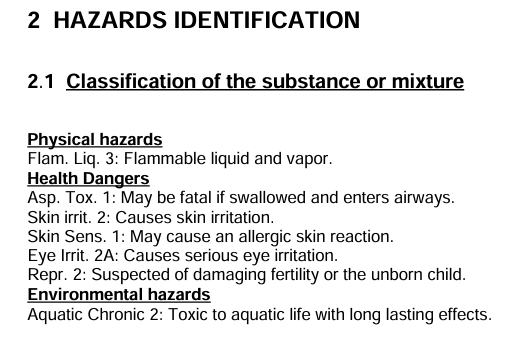
Here is the example that changed how I think about this completely. One hundred percent plant-based fragrance oil. The safety data sheet carries the signal word DANGER, not WARNING. Section 2 lists serious eye damage, an oral toxicity warning, and a confirmed acute inhalation toxicity classification, toxic if inhaled. It also carries Repr. 2, suspected of damaging fertility or the unborn child, traced to two separate compounds in the blend.
And under the industry's own usage guidelines, set by IFRA, the International Fragrance Association, the global body that determines how much of a given fragrance oil is considered safe across different product categories, that exact fragrance oil is approved for use in plug-ins, wicks, and candles at up to one hundred percent concentration. Not diluted. Not limited. Full strength, released continuously into the air of a home, breathed in by everyone in that room for as long as the plug-in stays on. You can read more about how these standards work directly at ifrafragrance.org.
That is not a synthetic fragrance I am describing. That is one hundred percent plant based, by label, by certificate, by every definition the industry uses for that term. Clean does not mean safe. Natural does not mean nontoxic. And the only place that information actually lives is in a document most people will never see.
Here is exactly what Repr. 2 means. It stands for Reproductive Toxicity, Category 2. This classification flags suspected, though not fully confirmed, evidence that an ingredient could damage fertility or harm an unborn child. It sits below Category 1, reserved for ingredients with stronger, more established evidence of reproductive harm. Suspected does not mean proven, but it also didn't offer enough reassurance for a product applied directly to skin, let alone diffused into the air of a home.
One hundred percent natural does not automatically mean free of reproductive toxins. A safe usage percentage for an essential oil does not automatically transfer to a fragrance oil just because both carry a plant-based label. That was a hard lesson to learn.
My fragrance standard had been built around plant based origin, on the assumption that anything from a plant was inherently safer than anything synthetic. That assumption was wrong, and it could have meant putting a real risk on real customers without anyone knowing it.
Learning to Read What I Hadn't Been Trained to Read
Here's something worth being transparent about. My training covers organic and natural skin care formulation, not fragrance chemistry, and certainly not fragrance oils I had long considered too toxic to touch. Once the need to actually evaluate them properly became clear, teaching myself how to do that started with the safety data sheet itself.
Months of research followed. Each hazard classification needed unpacking, what a Repr. 2 designation tells you, what skin sensitization warnings look like, how to read a document that wasn't written for someone with my background. Hundreds of safety data sheets later, fragrance by fragrance, most did not make the cut.
Along the way, something else surfaced that genuinely surprised me. Many suppliers don't even provide a safety data sheet at all. If I can't see exactly what's in a fragrance oil, along with any warnings attached to it, that fragrance gets disqualified immediately. No exceptions. If there's nothing to read, there's nothing to trust.
How to Actually Read One of These Sheets
I'm not going to turn this into a science lesson, because that's not how I learned it and it's not how you need to learn it either. Here is the short version, the part that actually matters.
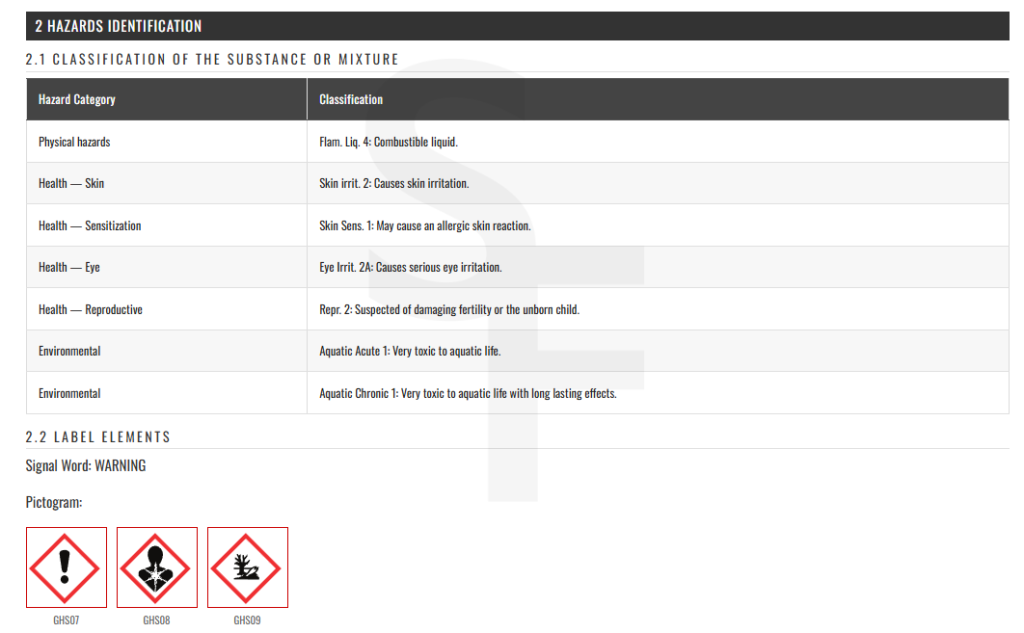
Every safety data sheet has a Section 2, usually titled Hazards Identification. That section is where the warnings live. Skip the rest if you need to, but read that part every time.
Inside Section 2, you'll see hazard categories listed with a number attached, things like Repr. 1 or Repr. 2, Skin Sens. 1 or Skin Sens. 2. Here's what those numbers actually mean. Category 1 means the danger is known and established. Category 2 means it's suspected, the evidence isn't fully confirmed, but there's enough concern that regulators require it to be disclosed anyway. Neither one is something I'm willing to put on skin, or in the air of someone's home.
What Happens Once It's in the Air
Here's something else worth knowing if you use fragrance in plug-ins, candles, or car air fresheners, anything that puts scent into the air you breathe continuously. IFRA's own usage guidelines allow fragrance oils to be used at up to one hundred percent concentration in those specific product categories, because that category isn't built around skin contact, it's built around what's released into the air. Reed diffusers are calculated a little differently and often carry a lower cap specific to that fragrance, but plug-ins, wicks, candles, and air fresheners consistently allow full strength. Released into the air means breathed in, by you, by your children, by your pets, continuously, for as long as that plug-in stays on or that candle keeps burning.

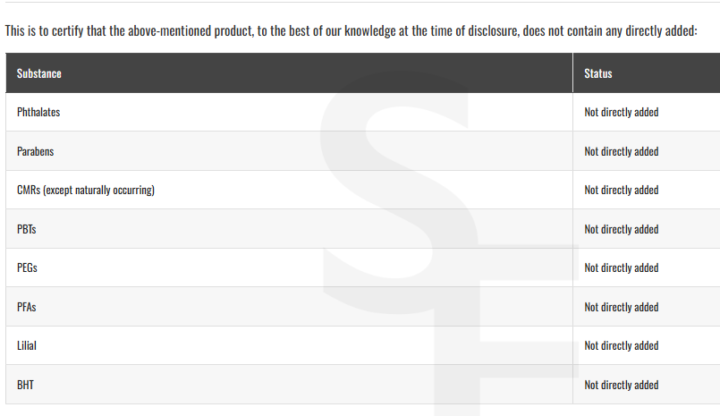
And here's the part that confused even me, and I formulate skin care for a living. A clean certification works off a list. The brand checks the product against that list, and if none of the restricted ingredients are present, the product earns the clean label. That's the whole test. The problem is the list only covers what's on the list. It doesn't test every ingredient actually in the product against every possible hazard. So, a fragrance oil can pass a clean certification completely honestly, while still containing other compounds, never covered by that list, that carry their own warnings for skin reaction, eye damage, reproductive risk, or inhalation toxicity. Clean means it passed one specific checklist. It doesn't mean someone checked everything.
What This Means for Our Products
Some of what I now use is natural. Some is plant based. Some is synthetic. All of it shares one thing in common, none carries a reproductive toxicity warning, a skin sensitization concern, or any other flag worth avoiding. Every single one also comes with a safety data sheet, personally reviewed before it ever reaches a formula. The standard was never really about plant versus synthetic, it was always about safety, and now the standard actually reflects that.
This isn't a step back from clean formulation. It's a more accurate version of what clean formulation actually requires, looking past a label and into the data behind it.
What's Changing on the Website
Several scents that did not meet this rebuilt standard have been removed from our products and listings. Our solid lotion bars and lotion pearls are already available, formulated with the fragrances that did clear review.
What I Know Now That I Didn't Before
Clean ingredients aren't defined by where they come from. They're defined by what the data says about them. A plant derived ingredient can carry real risk, while a synthetic one, properly vetted, can be entirely safe. Reading the safety data sheet instead of trusting the label is the only way to know the difference, and a supplier unwilling to provide one tells you something too.
That question gets asked for every fragrance sourced now, for every supplier, for every product carrying the Everlasting Organics name. And when something gets it wrong, as happened here, you'll hear about it, because that's the only kind of transparency that actually means anything.
Crafted by Faith. Purified by Nature.
0 Comments